
How to Make a Corrugated Box: A Complete Manufacturing Guide
Corrugated boxes are one of the most widely used packaging products in the world. They are used to transport, protect, store and display everything from food and electronics to industrial components and e-commerce products.
But how exactly is a corrugated box made?
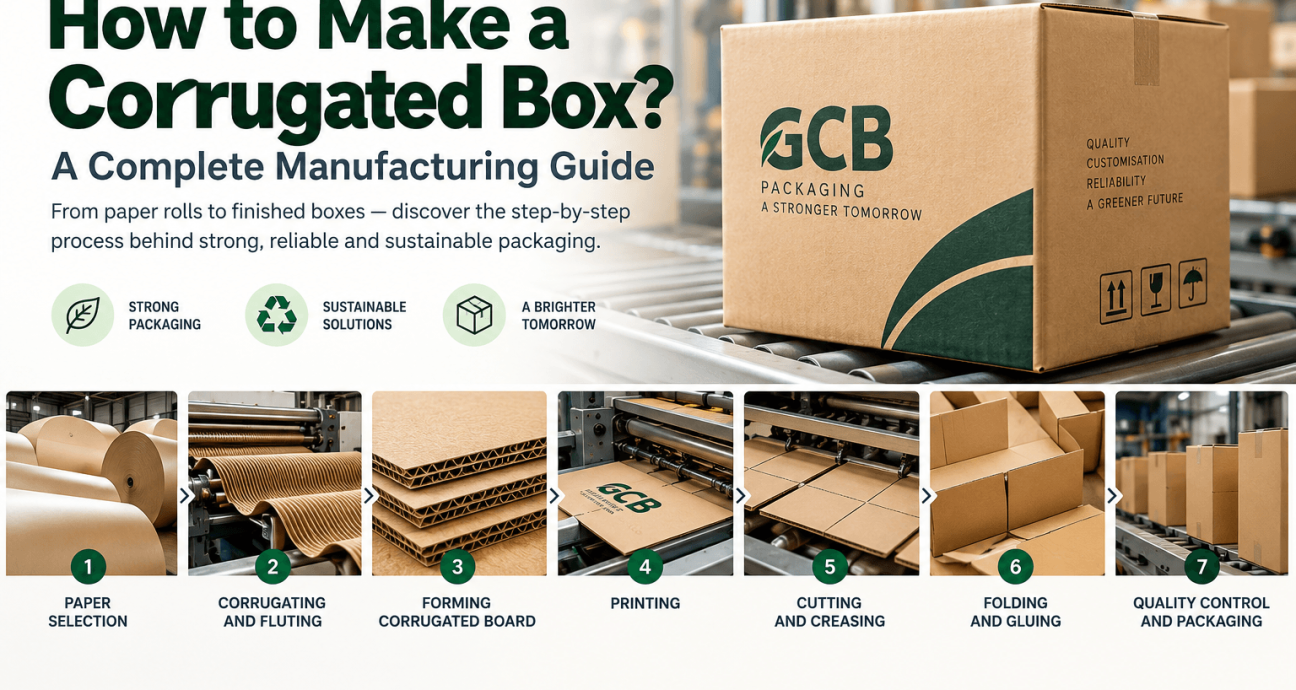
A typical corrugated box starts with large rolls of paper. These papers are processed into corrugated board by combining flat liner sheets with a fluted paper layer. The finished board is then printed, cut, creased, folded and glued or stitched to create the final carton box.
For businesses looking for corrugated box manufacturing in Malaysia, understanding this process can help you choose the right board, flute profile, box design and packaging specifications for your products.
In this guide, we explain how to make a corrugated box step by step, including the materials, machinery, manufacturing process, printing methods, quality checks and factors that determine box strength.
What Is a Corrugated Box?
A corrugated box is a packaging container made from corrugated fibreboard.
Unlike ordinary cardboard, corrugated board contains one or more layers of fluted paper sandwiched between flat liner sheets. The fluted layer creates air pockets that provide strength, cushioning and resistance to compression.
A basic corrugated board structure consists of:
- An outer liner
- A fluted medium
- An inner liner
The combination of these layers gives corrugated boxes their characteristic strength while keeping them relatively lightweight.
Depending on the application, manufacturers can produce different constructions, including:
- Single-wall corrugated board
- Double-wall corrugated board
- Triple-wall corrugated board
The appropriate construction depends on the product weight, stacking requirements, transportation conditions and desired level of protection.
How Are Corrugated Boxes Made?
The manufacturing process can be divided into several major stages:
- Paper selection
- Corrugating
- Combining the layers
- Cutting the corrugated board
- Printing
- Slotting and die-cutting
- Creasing
- Folding and gluing
- Quality control
- Bundling and delivery
Let’s look at each stage in detail.
1. Selecting the Paper
The first step in manufacturing a corrugated box is selecting the appropriate paper.
The two major paper components are:
Liner paper
Liner paper forms the flat outer surfaces of the corrugated board.
Depending on the application, the liner may be selected based on:
- Paper weight
- Strength
- Appearance
- Moisture resistance
- Printing requirements
- Recycled or virgin fibre content
The outer liner can also be selected to provide a suitable surface for printing logos, product information, graphics and branding.
Fluting medium
The fluting medium is the paper that becomes the wavy internal layer of the corrugated board.
The fluted structure provides much of the board’s stiffness and resistance to compression.
Different flute profiles provide different combinations of:
- Cushioning
- Compression strength
- Stacking strength
- Printing surface quality
- Thickness
Therefore, choosing the correct paper and flute combination is an important part of corrugated box design.
2. The Paper Enters the Corrugator
Large rolls of liner and fluting paper are fed into a machine called a corrugator.
The corrugator is one of the most important machines in a corrugated packaging factory.
It transforms flat paper into corrugated board.
The process involves several stages, including heating, conditioning, fluting, adhesive application and bonding.
The paper must be processed under controlled conditions because moisture and temperature can affect the quality and dimensional stability of the finished board.
3. Creating the Fluted Paper
The fluting medium passes through specially shaped corrugating rolls.
These rolls press the paper into a regular wave-like pattern.
The result is the familiar:
flute
shape found inside corrugated board.
The fluting provides separation between the liner sheets while creating a structure that can absorb forces and resist compression.
Different flute sizes are available for different packaging applications.
Common flute profiles include:
- A flute
- B flute
- C flute
- E flute
- F flute
Some manufacturers also combine different flute profiles to create specialised board constructions.
For example, a box designed for heavy industrial products may require a different board construction from a small retail box.
4. Applying Adhesive
Once the fluting has been formed, adhesive is applied to the tips of the flutes.
The fluted paper is then bonded to a liner.
This creates a basic corrugated structure.
The adhesive must be applied consistently.
Too little adhesive can result in poor bonding.
Too much adhesive can increase moisture, affect production efficiency and potentially cause problems with the finished board.
Manufacturers therefore control adhesive application carefully during production.
5. Forming Corrugated Board
After the fluted medium is bonded to the first liner, another liner can be attached depending on the required board construction.
For a typical single-wall corrugated board, the structure is:
Liner + Fluting + Liner
This produces a three-layer board.
For double-wall corrugated board, two fluted layers are used:
Liner + Fluting + Liner + Fluting + Liner
Double-wall board generally provides greater thickness and strength than single-wall board.
Triple-wall construction adds another fluted layer and is typically used for demanding heavy-duty applications.
6. Cutting the Corrugated Board
Once the corrugated board has been manufactured, large sheets or continuous board are cut into the required dimensions.
The board size depends on the box design.
At this stage, manufacturers must account for:
- Box length
- Box width
- Box height
- Flap dimensions
- Manufacturing joints
- Cutting tolerances
Accurate dimensions are important because even small errors can affect whether the finished box folds and closes correctly.
7. Printing the Box
Many corrugated boxes contain printed graphics.
Printing can communicate important information such as:
- Company logos
- Product names
- Handling instructions
- Product information
- Barcodes
- Recycling symbols
- Shipping information
- Brand graphics
Flexographic printing is commonly used for corrugated packaging because it can efficiently print onto corrugated board.
Depending on the packaging requirements, businesses may choose simple one- or two-colour printing or more elaborate multi-colour designs.
For e-commerce and branded packaging, printing can also become part of the customer experience.
8. Cutting and Slotting
The printed corrugated sheet is then processed to create the basic shape of the box.
Cutting and slotting machines create:
- Flaps
- Slots
- Panels
- Openings
- Handles
- Special features
Standard shipping cartons can often be produced using high-speed converting equipment.
More complicated packaging designs may require specialised tooling or die-cutting.
9. Creasing the Board
Creasing creates folding lines in the corrugated board.
These lines tell the board where it should bend.
Without properly positioned creases, a box can be difficult to assemble or may not form its intended shape.
Creasing is particularly important for:
- Folding cartons
- Die-cut boxes
- Display packaging
- Retail packaging
- Custom packaging designs
The crease must be compatible with the board thickness and flute direction.
10. Folding the Box
After cutting, slotting and creasing, the flat box blank is folded along its crease lines.
This transforms the flat sheet into the three-dimensional structure of the final box.
Most corrugated boxes are manufactured and supplied flat.
This allows manufacturers and customers to save storage and transportation space.
The customer can then erect the boxes when they are needed.
11. Gluing or Stitching
Depending on the box design and application, the manufacturer’s joint may be sealed using adhesive or stitching.
Glued boxes are widely used because they can be produced efficiently.
For certain heavy-duty packaging applications, stitching may also be appropriate.
The method depends on factors such as:
- Box size
- Board construction
- Product weight
- Transportation requirements
- Customer specifications
12. Quality Control
Before finished boxes leave the factory, they should be inspected to ensure that they meet the required specifications.
Quality control can include checking:
Dimensions
The finished box must match the specified dimensions.
Board quality
Manufacturers inspect the corrugated board for issues such as:
- Delamination
- Crushing
- Poor flute formation
- Uneven surfaces
- Inconsistent bonding
Printing
Printed boxes are checked for:
- Correct artwork
- Colour consistency
- Registration
- Legibility
- Barcode quality
Structural performance
Depending on the application, manufacturers may perform tests related to:
- Compression
- Bursting strength
- Edge crush
- Moisture resistance
- Box compression
Quality control becomes especially important when boxes are used for heavy products, export shipments or long-distance transportation.
What Determines the Strength of a Corrugated Box?
Not every corrugated box has the same strength.
Several factors influence box performance.
1. Paper Quality
The characteristics of the liner and fluting paper affect the strength of the finished board.
2. Board Construction
Single-wall, double-wall and triple-wall boards provide different levels of structural performance.
3. Flute Profile
The flute profile affects thickness, stiffness, cushioning and compression characteristics.
4. Box Dimensions
A larger box may require a different board specification because the panels have greater unsupported surface area.
5. Product Weight
A lightweight retail product does not necessarily require the same packaging construction as a heavy industrial component.
6. Stacking Conditions
Boxes that will be stacked in a warehouse or transportation environment may require additional compression strength.
7. Transportation Environment
Humidity, temperature, handling and transportation duration can affect packaging performance.
For this reason, the cheapest box is not necessarily the most appropriate box for every application.
What Is the Difference Between Cardboard and Corrugated Board?
The terms “cardboard” and “corrugated board” are sometimes used interchangeably, but they are not exactly the same.
Cardboard is a broad term used for paper-based board materials.
Corrugated board specifically contains a fluted layer bonded between liner sheets.
The fluted structure gives corrugated board its distinctive strength-to-weight characteristics.
This makes corrugated boxes particularly useful for shipping and transportation.
What Are the Main Types of Corrugated Boxes?
There are many corrugated box designs.
Some of the most common include:
Regular Slotted Carton
The Regular Slotted Carton, or RSC, is one of the most common corrugated box styles.
It is widely used for:
- Shipping
- Warehousing
- E-commerce
- Industrial packaging
- General product packaging
Full Overlap Box
A full-overlap box has flaps that completely overlap when closed.
This design can provide additional protection and strength for certain applications.
Die-Cut Box
Die-cut boxes are produced using specialised tooling.
They are useful when a packaging design requires:
- Unique shapes
- Handles
- Display features
- Locking mechanisms
- Special openings
Heavy-Duty Corrugated Box
Heavy-duty boxes use stronger board constructions and are designed for applications involving heavier products or demanding transportation conditions.
How Do You Choose the Right Corrugated Box?
Before ordering custom corrugated boxes, businesses should consider several factors.
Product dimensions
Measure:
- Length
- Width
- Height
Consider whether the product requires internal cushioning or protective inserts.
Product weight
The heavier the product, the more important board strength and box construction become.
Shipping method
Consider whether the box will be transported by:
- Courier
- Lorry
- Container
- Air freight
- Sea freight
Different transportation environments can create different packaging demands.
Stacking requirements
If cartons will be stacked during storage or transportation, compression strength becomes particularly important.
Moisture exposure
Products transported or stored in humid environments may require appropriate material selection or additional protection.
Printing requirements
Determine whether you need:
- Basic shipping information
- One-colour branding
- Multi-colour graphics
- Product information
- Barcodes
Quantity
Production volume can influence the most appropriate manufacturing method and packaging cost.
How Much Does It Cost to Make a Corrugated Box?
There is no single price for a corrugated box.
The manufacturing cost depends on several variables, including:
- Box dimensions
- Paper grade
- Paper weight
- Flute type
- Board construction
- Printing
- Die-cutting
- Order quantity
- Special coatings
- Adhesive or stitching requirements
- Delivery location
For example, a small plain single-wall shipping carton will generally have very different material and production requirements from a large printed double-wall industrial box.
For businesses in Malaysia, it is therefore better to provide the packaging manufacturer with the product dimensions, expected quantity and application rather than asking only for a generic “price per box.”
Can Corrugated Boxes Be Recycled?
Yes.
Corrugated fibreboard is widely recyclable when it is clean and appropriately handled through recycling systems.
One of the advantages of paper-based corrugated packaging is that the material can be recovered and processed into paper fibre for subsequent applications.
However, recyclability can be affected by contamination, coatings, laminations, adhesives and other materials incorporated into the packaging.
Businesses interested in sustainable packaging should therefore discuss material selection with their packaging supplier.
How Corrugated Boxes Are Made in a Commercial Factory
A commercial corrugated box manufacturing process can be summarised as:
Paper Rolls
↓
Paper Conditioning
↓
Corrugating
↓
Flute Formation
↓
Liner Bonding
↓
Corrugated Board
↓
Printing
↓
Cutting & Slotting
↓
Creasing
↓
Folding
↓
Gluing / Stitching
↓
Quality Inspection
↓
Bundling
↓
Delivery
This process allows packaging manufacturers to produce everything from standard shipping cartons to highly customised packaging solutions.
Why Work With a Corrugated Box Manufacturer?
Businesses that purchase large quantities of packaging may benefit from working directly with a corrugated box manufacturer rather than purchasing generic cartons.
A manufacturer can help with:
- Box design
- Material selection
- Board construction
- Flute selection
- Printing
- Die-cutting
- Structural testing
- Production
- Quality control
- Delivery planning
This is particularly useful when packaging needs to be designed around a specific product.
For example, an electronics manufacturer may have completely different packaging requirements from a food manufacturer, furniture company or e-commerce seller.
Corrugated Box Manufacturing in Malaysia
Malaysia has a large manufacturing and logistics sector, creating demand for reliable packaging solutions across many industries.
Businesses may require corrugated packaging for:
- Manufacturing
- Electronics
- Food and beverage
- Automotive components
- Furniture
- Consumer goods
- E-commerce
- Warehousing
- Export shipments
- Industrial products
When choosing a corrugated box manufacturer in Malaysia, businesses should consider more than just the quoted price.
Important questions include:
- Can the supplier manufacture the required box dimensions?
- What board constructions are available?
- What flute profiles are available?
- Can the supplier produce custom designs?
- Can they print branding?
- What quality-control procedures are used?
- What is the minimum order quantity?
- What is the production lead time?
- Can they support repeat orders?
- Can they deliver to the required location?
A supplier with suitable manufacturing capabilities can help businesses balance packaging protection, cost, appearance and production efficiency.
GCB: Corrugated Packaging Manufacturer in Malaysia
Golden Corrugated Box (M) Sdn Bhd, commonly known as GCB, is a Malaysian corrugated packaging manufacturer based in Beranang, Selangor.
GCB provides corrugated packaging solutions including corrugated board, corrugated carton boxes, custom packaging and paper pallets.
For businesses looking for a corrugated box supplier in Selangor or Malaysia, working with a manufacturer that understands the complete production process can make it easier to develop packaging according to the product’s dimensions, weight, transportation requirements and branding needs.
The right packaging specification should be based on the application rather than simply selecting the cheapest available box.
Frequently Asked Questions About Corrugated Boxes
How is a corrugated box made?
A corrugated box is made by converting paper rolls into corrugated board, cutting and printing the board, creating crease and fold lines, and then folding and gluing or stitching the box into its final form.
What are corrugated boxes made from?
Corrugated boxes are primarily made from paper-based materials, consisting of flat liner sheets and one or more fluted paper layers.
What makes corrugated boxes strong?
The fluted paper layer creates a structural framework between the liner sheets. Paper properties, flute profile, board construction, box design and manufacturing quality all influence the final box strength.
What is the difference between single-wall and double-wall corrugated boxes?
A single-wall board generally consists of two liners and one fluted layer. A double-wall board contains three liner layers and two fluted layers, providing a thicker construction for applications that require additional structural performance.
What type of corrugated box is best for shipping?
The appropriate box depends on the product weight, dimensions, fragility, stacking conditions and transportation environment. A packaging manufacturer can recommend a suitable board construction based on these requirements.
Can I make a corrugated box at home?
A simple corrugated box can be made manually from existing corrugated board using a cutting tool, ruler, scoring tool and adhesive. However, commercial packaging requires controlled material selection, accurate converting, printing and quality testing.
Can corrugated boxes be customised?
Yes. Corrugated boxes can be customised in terms of dimensions, board construction, flute profile, printing, die-cut shapes, handles, openings and closure designs.
Where can I find a corrugated box manufacturer in Malaysia?
Businesses can work directly with Malaysian corrugated packaging manufacturers that provide custom board and carton manufacturing. When comparing suppliers, consider manufacturing capabilities, quality requirements, production capacity, lead time and delivery requirements.
Final Thoughts
A corrugated box may look simple, but manufacturing a reliable carton involves much more than cutting and folding paper.
The process starts with selecting suitable paper and continues through corrugation, flute formation, adhesive bonding, board production, printing, cutting, creasing, folding, gluing and quality control.
The most suitable box depends on the product it needs to protect.
Before ordering corrugated packaging, businesses should consider the product’s dimensions, weight, transportation conditions, stacking requirements, moisture exposure, branding requirements and expected order volume.
For companies looking for corrugated boxes, custom carton packaging or corrugated board in Malaysia, understanding the manufacturing process is a useful first step toward selecting the right packaging specification.
A well-designed corrugated box can provide the right balance between protection, strength, cost, storage efficiency and presentation.