
When choosing packaging for heavy, fragile or high-value products, one question often comes up:
What is the strongest type of corrugated box?
The simple answer is that there is no single corrugated box that is automatically the strongest for every application.
For demanding packaging applications, double-wall and triple-wall corrugated boxes generally provide greater structural strength than standard single-wall boxes. However, the actual performance of a corrugated box also depends on the paper grade, flute profile, board construction, box dimensions, design, manufacturing quality, product weight, stacking conditions and transportation environment.
A properly designed single-wall box can be more suitable than an unnecessarily heavy triple-wall box for some products.
For businesses looking for a strong corrugated box manufacturer in Malaysia, understanding these differences is important because choosing the right packaging is not simply about selecting the thickest board.
This guide explains the strongest types of corrugated boxes, the difference between single-wall, double-wall and triple-wall construction, flute profiles, box strength tests and how to choose the right packaging for your products.
What Makes a Corrugated Box Strong?
The strength of a corrugated box comes from several components working together.
The main factors include:
- Paper quality
- Liner strength
- Fluting medium
- Flute profile
- Number of board layers
- Board thickness
- Box dimensions
- Box design
- Joint construction
- Printing and converting processes
- Moisture and environmental conditions
- Stacking conditions
- Product weight
- Manufacturing quality
This means that simply asking for the “thickest box” may not result in the best packaging solution.
A strong packaging design should provide the right balance between compression strength, impact protection, weight, cost and handling requirements.
What Is the Strongest Corrugated Box?
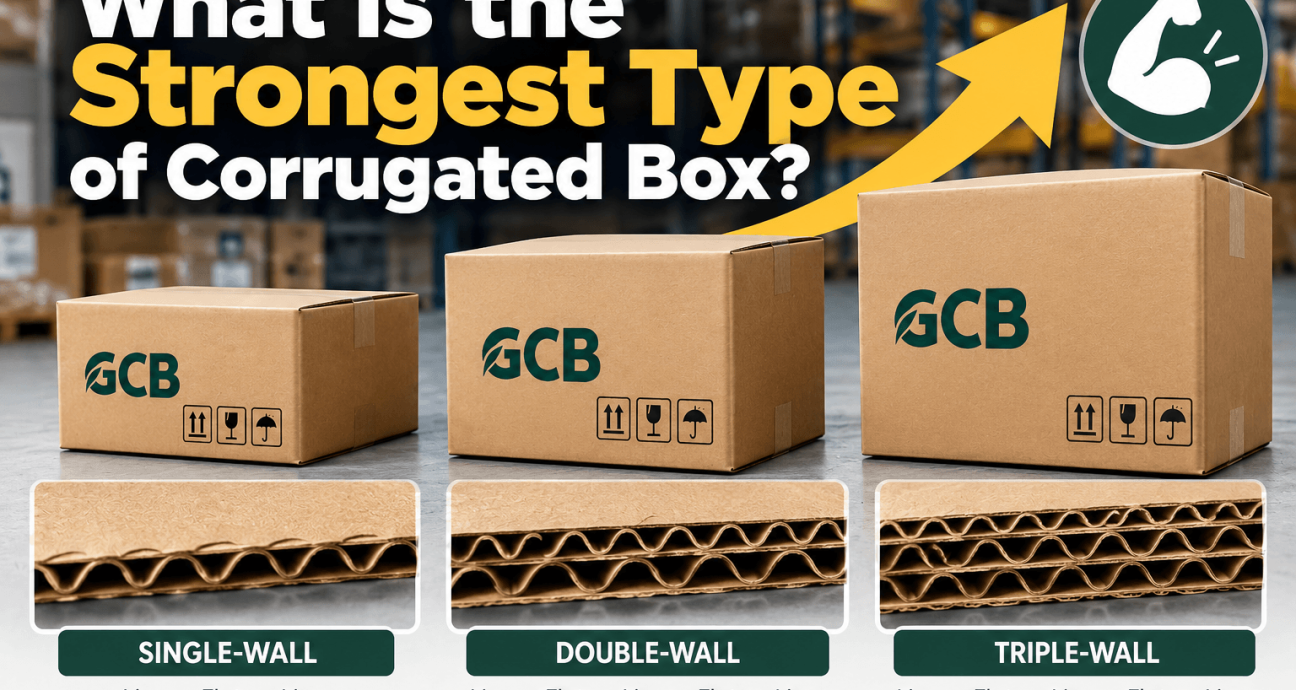
For applications requiring very high structural strength, triple-wall corrugated boxes are generally among the strongest conventional corrugated packaging options.
Triple-wall construction contains:
4 liner layers + 3 fluted layers
The multiple layers create a thick, rigid board structure capable of supporting demanding applications.
However, double-wall corrugated boxes can provide excellent strength while being lighter and more economical than triple-wall construction.
For many industrial, logistics and shipping applications, double-wall corrugated packaging can provide an excellent balance between strength, protection and cost.
Therefore:
For maximum conventional board construction:
Triple-wall
For strong, practical heavy-duty packaging:
Double-wall
For general-purpose packaging:
Single-wall
The correct choice ultimately depends on the application.
Understanding Single-Wall Corrugated Boxes
Single-wall corrugated board is one of the most widely used forms of corrugated packaging.
Its basic construction is:
Liner + Fluting + Liner
The fluted medium is positioned between two flat liner sheets.
Single-wall boxes are commonly used for:
- E-commerce packaging
- General shipping
- Consumer products
- Food packaging
- Retail packaging
- Electronics
- Household products
- Light industrial products
Single-wall does not mean weak.
The performance of a single-wall box can vary significantly depending on the paper grade and flute profile.
For many products, a well-designed single-wall box provides sufficient protection without the additional material and weight of a double-wall or triple-wall box.
What Is a Double-Wall Corrugated Box?
Double-wall corrugated board contains two fluted layers separated by a liner.
Its basic construction is:
Liner + Flute + Liner + Flute + Liner
This additional fluted layer increases board thickness and can improve structural performance compared with many single-wall constructions.
Double-wall boxes are commonly considered when packaging needs to withstand:
- Heavier products
- Greater stacking loads
- Longer transportation
- Rougher handling
- Warehousing
- Industrial applications
- Export shipping
For many businesses, double-wall corrugated packaging provides an excellent compromise between strength and cost.
What Is a Triple-Wall Corrugated Box?
Triple-wall corrugated board contains three fluted layers.
Its basic construction is:
Liner + Flute + Liner + Flute + Liner + Flute + Liner
This creates a substantially thicker board structure.
Triple-wall corrugated boxes are typically considered for demanding applications where high structural performance is required.
Potential applications include:
- Heavy machinery components
- Industrial equipment
- Automotive components
- Large parts
- Heavy products
- Export packaging
- Large-format packaging
- Products requiring substantial stacking strength
However, triple-wall packaging is not automatically the best choice simply because it has more layers.
The packaging should still be engineered around the product and its transportation conditions.
Single-Wall vs Double-Wall vs Triple-Wall Corrugated Boxes
Here’s a simple comparison:
| Feature | Single-Wall | Double-Wall | Triple-Wall |
|---|---|---|---|
| Fluted layers | 1 | 2 | 3 |
| Liner layers | 2 | 3 | 4 |
| Thickness | Lower | Higher | Highest |
| Weight | Lower | Medium | Higher |
| Structural strength | Good | Very good | Excellent |
| Heavy-duty applications | Limited to suitable designs | Suitable | Highly suitable |
| Stacking performance | Good depending on specification | Higher | Very high |
| Material usage | Lower | Higher | Highest |
| Typical application | General packaging | Heavy-duty packaging | Very heavy-duty packaging |
The exact performance depends on the paper grades, flute combinations and box design.
Does Thicker Corrugated Board Always Mean Stronger?
Not necessarily.
This is one of the most important things to understand when selecting packaging.
A thicker board may provide greater stiffness and structural performance, but thickness alone does not determine box strength.
Other factors matter.
For example:
- Paper strength
- Edge Crush Test performance
- Box dimensions
- Box geometry
- Flute configuration
- Moisture
- Joint construction
- Compression requirements
- Stacking arrangement
A well-designed box using a suitable board specification can outperform a poorly designed box made from thicker material.
That’s why professional packaging manufacturers look at the complete application rather than simply recommending the thickest available board.
What Is the Strongest Flute for Corrugated Boxes?
Corrugated board comes in different flute profiles.
Common flute types include:
- A flute
- B flute
- C flute
- E flute
- F flute
Each has different characteristics.
A Flute
A flute is relatively tall and provides good cushioning and compression characteristics.
It can be suitable when protection and stacking performance are important.
B Flute
B flute is thinner than A flute and can provide a good balance between strength and material efficiency.
It is commonly used in many packaging applications.
C Flute
C flute provides a combination of cushioning, stiffness and stacking performance.
It is widely used for shipping and general packaging applications.
E Flute
E flute is much finer and is often selected for thinner packaging with a relatively smooth printing surface.
It can be useful for retail packaging and applications where appearance is important.
F Flute
F flute is even finer and is used in applications where a thin board and good printability are desirable.
Which Flute Is the Strongest?
There is no universal answer.
A thicker flute does not automatically mean the finished box will have the highest overall strength.
For example, one flute profile may provide better cushioning while another may provide advantages in stacking or printing.
The right flute depends on:
- Product weight
- Product fragility
- Box dimensions
- Stacking requirements
- Shipping environment
- Printing requirements
- Desired box thickness
Manufacturers can also combine flute profiles in double-wall constructions.
For example, combinations of different flute profiles can be selected to balance stiffness, cushioning and compression performance.
What Is a Double-Wall BC Flute Box?
A common heavy-duty corrugated construction is a BC flute combination.
It combines two different flute profiles within a double-wall board.
This type of construction can provide a combination of:
- Thickness
- Compression resistance
- Cushioning
- Stacking performance
- Structural rigidity
BC flute boxes are often considered for heavier products and demanding transportation conditions.
However, the appropriate specification should still be selected according to the product and packaging requirements.
What Is a Triple-Wall Corrugated Box Used For?
Triple-wall corrugated boxes are generally used when packaging requirements exceed what a typical single-wall or double-wall box can comfortably provide.
Potential applications include:
Heavy industrial equipment
Large and heavy components can place substantial loads on packaging.
Automotive parts
Automotive components may require packaging that can tolerate handling, stacking and transportation.
Export packaging
Long-distance transportation may expose boxes to repeated handling and varying environmental conditions.
Heavy machinery components
Industrial parts can require significantly stronger packaging than ordinary consumer products.
Large products
Large box dimensions can create additional structural challenges, making board specification particularly important.
What Is the Strongest Corrugated Box for Shipping?
The strongest box for shipping depends on what you are shipping.
A small, lightweight electronic product does not necessarily require triple-wall packaging.
A heavy industrial component may require double-wall or triple-wall construction.
When selecting shipping packaging, consider:
1. Product weight
Heavier products place greater loads on the box.
2. Product dimensions
Large boxes have larger panels and may require additional structural support.
3. Fragility
Fragile products may require cushioning in addition to a strong outer box.
4. Stacking
Boxes transported on pallets may be stacked during storage or shipping.
5. Transportation distance
Longer transportation can mean more handling and exposure to different environments.
6. Moisture
Humidity can affect paper-based packaging materials.
7. Handling
Courier, warehouse and logistics operations can expose cartons to impacts and compression.
The strongest packaging is therefore the packaging engineered for the actual shipping conditions.
How Is Corrugated Box Strength Tested?
Corrugated packaging manufacturers use different tests to evaluate board and box performance.
The appropriate test depends on the packaging application.
Edge Crush Test (ECT)
The Edge Crush Test measures the ability of corrugated board to resist crushing when force is applied to its edge.
ECT is particularly relevant when evaluating stacking performance.
A higher ECT value generally indicates greater resistance to edge compression.
Box Compression Test (BCT)
The Box Compression Test evaluates how much compressive force a finished box can withstand before it deforms or collapses.
This can be especially important when cartons are stacked.
BCT performance depends on more than just the board material.
It can also be affected by:
- Box dimensions
- Box height
- Box width
- Box length
- Board construction
- Flute direction
- Box design
- Environmental conditions
Burst Strength
Burst strength measures the resistance of paperboard to bursting under pressure.
It can provide useful information about the material’s resistance to puncture and bursting forces.
However, burst strength should not be used alone to determine whether a box is suitable for a particular application.
Why Box Design Matters
The strength of the finished package isn’t determined only by the board.
The geometry of the box also matters.
Important design factors include:
- Box dimensions
- Flap design
- Score lines
- Panel proportions
- Joint construction
- Cut-outs
- Handles
- Openings
- Internal inserts
For example, large boxes can experience different compression forces compared with small cartons.
A packaging manufacturer can therefore help optimise the box dimensions and board specification together.
How Moisture Affects Corrugated Box Strength
Paper-based packaging can be affected by moisture.
High humidity can reduce the structural performance of corrugated board.
This becomes especially important when cartons are:
- Stored in humid warehouses
- Transported by sea
- Exposed to rain
- Used in refrigerated environments
- Stored for long periods
Businesses with moisture-sensitive applications should discuss suitable board and packaging requirements with their corrugated box manufacturer.
Is a Triple-Wall Box Always Better Than a Double-Wall Box?
No.
A triple-wall box may provide additional structural performance, but that doesn’t automatically make it the best solution.
There are several reasons to choose double-wall packaging instead.
Lower weight
A double-wall box can be lighter than an equivalent triple-wall construction.
Lower material usage
Using only the necessary material can improve packaging efficiency.
Easier handling
Lighter packaging can be easier for workers and logistics teams to handle.
Lower transportation impact
Reducing unnecessary packaging weight can help reduce transportation requirements.
Lower cost
Triple-wall construction may cost more because it uses additional material.
The objective should therefore be:
Use enough strength to protect the product — without unnecessarily over-engineering the packaging.
How to Choose the Strongest Corrugated Box for Your Product
Before ordering a heavy-duty corrugated box, gather the following information.
Product dimensions
Provide:
- Length
- Width
- Height
Product weight
State the approximate gross weight of the product and packaging.
Stacking requirements
Explain how many cartons will be stacked.
Transportation method
Specify whether the product will be transported by:
- Road
- Air
- Sea
- Courier
- Container
- Mixed transportation
Storage environment
Mention whether the boxes will be stored:
- Indoors
- Outdoors
- In a humid environment
- In a temperature-controlled facility
Product fragility
Tell the packaging manufacturer whether the product is:
- Fragile
- Heavy
- Sharp
- Irregularly shaped
- Sensitive to moisture
Order quantity
The expected production volume can affect material and manufacturing considerations.
With this information, a packaging manufacturer can recommend a more appropriate board construction.
Strongest Corrugated Box: Quick Guide
If you’re looking for a simple starting point:
Lightweight products
Consider:
Single-wall corrugated boxes
Medium-weight products
Consider:
Higher-grade single-wall or double-wall boxes
Heavy products
Consider:
Double-wall corrugated boxes
Very heavy or demanding applications
Consider:
Triple-wall corrugated boxes
Export and industrial applications
Consider:
Engineered double-wall or triple-wall packaging based on the product and transportation conditions
These are starting points rather than universal rules.
Strong Corrugated Boxes for Malaysian Businesses
Businesses in Malaysia operate across a wide range of manufacturing, logistics and export industries.
Common applications for heavy-duty corrugated packaging include:
- Electronics
- Automotive
- Manufacturing
- Furniture
- Machinery
- Food and beverage
- Consumer products
- Industrial components
- E-commerce
- Export shipments
Malaysia’s warm and humid climate can also make material selection and storage conditions important considerations for paper-based packaging.
For businesses shipping products domestically or internationally, packaging should be designed around the actual supply chain rather than selected based only on box thickness.
What Should You Ask a Corrugated Box Manufacturer?
Before placing an order, consider asking your packaging supplier:
- What board construction is suitable for my product?
- Should I use single-wall, double-wall or triple-wall?
- Which flute combination is appropriate?
- What paper grades are available?
- What is the expected ECT or compression performance?
- Does the box require moisture considerations?
- Can the dimensions be customised?
- Can the box be printed?
- What quality-control tests are performed?
- What is the minimum order quantity?
- What is the production lead time?
- Can the manufacturer provide packaging recommendations?
A good corrugated packaging supplier should be able to discuss these factors rather than simply quoting a price per carton.
Corrugated Box Manufacturer in Malaysia
For businesses looking for strong and reliable corrugated packaging, working with an experienced corrugated box manufacturer in Malaysia can help ensure that the board construction matches the actual application.
Golden Corrugated Box (M) Sdn Bhd (GCB) is a Malaysian corrugated packaging manufacturer based in Beranang, Selangor.
GCB provides corrugated packaging solutions including:
Corrugated board
Corrugated carton boxes
Custom packaging
Paper pallets
The appropriate packaging specification depends on the product, dimensions, weight, transportation requirements and desired performance.
Instead of simply choosing the thickest box available, businesses can work with a packaging manufacturer to identify the right combination of paper grade, flute profile, board construction and box design.
Frequently Asked Questions
What is the strongest type of corrugated box?
Triple-wall corrugated boxes are generally among the strongest conventional corrugated box constructions because they contain three fluted layers. However, a properly engineered double-wall box may be more appropriate for many heavy-duty applications.
Is double-wall stronger than single-wall corrugated board?
Generally, double-wall corrugated board provides greater structural thickness and can provide higher strength than many single-wall constructions. Actual performance depends on paper grade, flute combination, box design and testing requirements.
Is triple-wall stronger than double-wall?
Triple-wall construction generally provides greater thickness and structural capability than double-wall construction. However, the additional material may not be necessary for every product.
What is the best flute for strong boxes?
There is no single “strongest” flute for every application. Flute selection depends on requirements such as compression, cushioning, stiffness, box dimensions and printing.
What is BC flute?
BC flute is a double-wall corrugated construction combining B flute and C flute. It can provide a useful combination of thickness, stiffness, cushioning and structural performance.
Are thicker corrugated boxes stronger?
Not necessarily. Board thickness is only one factor. Paper strength, flute profile, box dimensions, design, moisture and manufacturing quality can all influence the finished box’s performance.
What is the strongest box for heavy products?
Heavy products may require double-wall or triple-wall corrugated boxes, depending on the product weight, dimensions, stacking requirements and transportation conditions.
How can I make a corrugated box stronger?
A box can potentially be strengthened by selecting an appropriate paper grade, flute profile, board construction and box design. Increasing board thickness is only one possible solution.
Are triple-wall boxes suitable for export?
They can be suitable for demanding export applications, particularly where heavy products or high stacking loads are involved. The packaging should be selected according to the specific export conditions.
How do I choose a strong corrugated box manufacturer in Malaysia?
Look for a manufacturer that can provide different board constructions, flute options, custom dimensions, printing, quality control and packaging recommendations based on your product requirements.
Conclusion: The Strongest Box Is the Right Box
So, what is the strongest type of corrugated box?
For conventional corrugated packaging, triple-wall corrugated boxes generally offer the highest level of board construction, followed by double-wall and single-wall designs.
But the strongest box isn’t necessarily the best box.
The ideal packaging solution is one that provides enough strength to protect the product throughout its journey while avoiding unnecessary material, weight and cost.
For many applications, a properly specified double-wall corrugated box can provide an excellent balance of strength, protection and efficiency.
The best way to determine the right packaging is to consider:
Product → Weight → Dimensions → Board → Flute → Box Design → Transportation → Stacking → Environment
If you are sourcing strong corrugated boxes or custom packaging in Malaysia, provide your packaging manufacturer with these details so they can recommend a board construction designed for your actual requirements.