
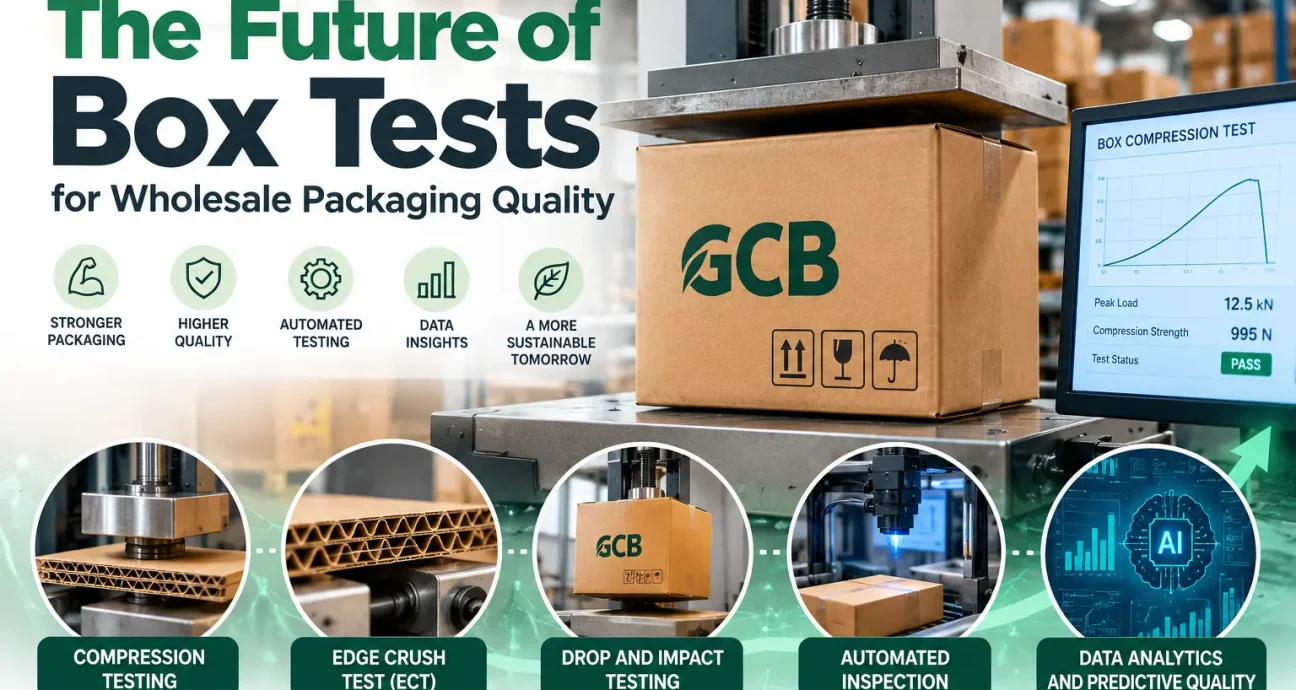
As supply chains become more complex and customer expectations continue to rise, packaging quality is becoming increasingly important for manufacturers, wholesalers, distributors and logistics companies.
Corrugated boxes are used to transport products across industries, including electronics, food and beverage, automotive, consumer goods, e-commerce and industrial manufacturing.
Although a corrugated carton may appear simple, its performance can directly affect product protection, shipping costs, warehouse efficiency and customer satisfaction.
For businesses purchasing wholesale packaging, one important question is becoming more relevant:
How can manufacturers ensure that corrugated boxes consistently meet the strength and quality requirements of modern supply chains?
The answer lies in the evolution of box testing.
Traditional methods such as the Edge Crush Test (ECT), Box Compression Test (BCT) and burst strength testing remain important. However, improvements in automation, digital measurement, data analysis, material engineering and sustainability are changing how packaging quality can be assessed and managed.
For businesses sourcing corrugated boxes in Malaysia, understanding these developments can help them make better purchasing decisions and work more effectively with packaging manufacturers.
This article explores the future of box testing for wholesale packaging quality, the testing methods used today, emerging technologies and the factors businesses should consider when choosing a corrugated box supplier.
What Is Box Testing in Packaging?
Box testing is the process of evaluating whether a packaging box can meet its intended performance requirements.
For corrugated packaging, testing may examine the strength of the board, the compression resistance of the finished box, the quality of the adhesive bond, the accuracy of the dimensions and the ability of the packaging to protect its contents during transportation.
The purpose is not simply to determine whether a box is strong.
It is to establish whether the packaging is suitable for its intended product, storage conditions, transportation environment and handling requirements.
For wholesale packaging buyers, box testing can help answer several important questions:
- Can the box support the expected stacking load?
- Is the corrugated board suitable for the product’s weight?
- Can the packaging withstand normal handling during transportation?
- Are the box dimensions consistent across production batches?
- Does the box meet the customer’s specifications?
- Can material usage be reduced without compromising protection?
These questions become especially important when businesses order thousands or tens of thousands of cartons at a time.
A small quality issue repeated across a large production run can create substantial operational problems.
Why Packaging Quality Testing Matters for Wholesale Buyers
Wholesale packaging involves more than purchasing boxes at the lowest available price.
A reliable packaging solution must balance cost, strength, consistency and suitability for the product.
1. Protecting products during transportation
Corrugated boxes may experience compression, vibration, impacts and repeated handling during distribution.
If the packaging is unsuitable, products can become damaged before reaching their destination.
Appropriate box testing helps manufacturers and buyers assess whether the packaging is suitable for the expected conditions.
2. Reducing product damage and returns
Damaged products can lead to replacement costs, returns, customer complaints and additional transportation expenses.
Packaging that has been properly specified and tested can help reduce the risk of these problems.
However, the effectiveness of packaging also depends on the product design, internal cushioning, packing method and actual distribution environment.
3. Maintaining consistent wholesale quality
A packaging specification should produce predictable results across repeat orders.
Quality checks help identify variations in board construction, dimensions, adhesive bonding and other manufacturing characteristics.
This is particularly important for businesses that rely on recurring bulk packaging orders.
4. Improving warehouse and pallet efficiency
Boxes are often stacked in warehouses, distribution centres and shipping containers.
Packaging that cannot withstand the required stacking load may deform or collapse.
Testing helps businesses determine whether their cartons are appropriate for the intended stacking arrangement.
5. Supporting export requirements
Export packaging may experience long transportation periods, multiple handling stages and changes in temperature or humidity.
For Malaysian exporters, packaging quality is an important consideration when shipping products domestically or internationally.
The appropriate tests depend on the product, destination, transport method and buyer requirements.
Traditional Box Testing Methods That Remain Important
Although testing technology is evolving, established methods remain essential for evaluating corrugated packaging performance.
The future of box testing is more likely to improve how these methods are applied than to eliminate the need for them.
1. Edge Crush Test (ECT)
The Edge Crush Test measures the resistance of corrugated board to crushing when force is applied to its edge.
ECT is particularly relevant when evaluating the board’s resistance to edge compression, which can contribute to the stacking performance of a finished carton.
A higher ECT value generally indicates greater edge-crush resistance under the specified test conditions.
However, ECT alone does not determine the strength of a complete box.
Box dimensions, board construction, humidity, box design and stacking conditions also influence finished-box performance.
For wholesale packaging buyers, ECT results can help compare board specifications when the test method and material requirements are consistent.
2. Box Compression Test (BCT)
The Box Compression Test evaluates how much compressive force a finished box can withstand before reaching a defined failure or deformation point.
This test is especially useful for cartons that will be stacked in warehouses, on pallets or during transportation.
BCT can help manufacturers and buyers understand how a finished box performs under compression.
The results may be affected by:
- Box length, width and height
- Corrugated board construction
- Paper properties
- Flute profile
- Box joints and closures
- Moisture content
- Test conditions
A box with a high compression result under laboratory conditions may not perform identically in a humid warehouse or under a different stacking arrangement.
Testing should therefore reflect the intended application as closely as practical.
3. Burst Strength Testing
Burst strength testing measures the resistance of a paper-based material to bursting under pressure.
It can provide useful information about the properties of corrugated packaging materials.
However, burst strength should not be treated as a complete measure of box performance.
A carton used for stacking heavy products may require particular attention to compression performance, while another application may require greater emphasis on puncture resistance or cushioning.
The appropriate tests depend on the product and the risks the packaging must manage.
4. Moisture and Humidity Testing
Paper-based packaging can lose strength when exposed to high humidity or moisture.
This is an important consideration for businesses operating in Malaysia’s tropical climate.
Cartons may be stored in humid warehouses, transported through changing environmental conditions or shipped by sea.
Moisture-related testing and environmental conditioning can help businesses understand how packaging materials behave under specified conditions.
For demanding applications, packaging should be evaluated under conditions that reasonably represent its intended storage and transportation environment.
5. Dimensional and Visual Inspection
Not every quality problem requires a specialised laboratory test.
Dimensional inspection checks whether cartons match their specified length, width, height and other design requirements.
Visual inspection can identify issues such as:
- Crushed flutes
- Poor adhesive bonding
- Damaged edges
- Incorrect printing
- Inconsistent cutting
- Defective creases
- Misaligned joints
These checks are important because a box that fails to fold, close or fit its contents correctly can create problems even when its board strength is adequate.
The Future of Box Testing: Five Important Developments
The future of corrugated packaging quality testing is likely to involve greater automation, better data collection and more integrated quality management.
The following developments offer practical opportunities for manufacturers and wholesale packaging buyers.
1. Automated Quality Inspection
Manual inspection remains useful, but automated systems can help manufacturers inspect products more consistently.
Depending on the equipment, automated inspection may use cameras, sensors and measurement systems to identify defects or deviations from specified tolerances.
Potential inspection applications include:
- Detecting printing defects
- Checking dimensions
- Identifying surface damage
- Monitoring cutting accuracy
- Detecting misaligned printing
- Checking production consistency
Machine vision systems can compare images against defined quality criteria and flag potential problems for further inspection.
In a high-volume packaging factory, automation may help identify defects earlier and reduce reliance on purely visual checks.
However, automated inspection still requires appropriate equipment calibration, validated detection criteria and human oversight.
Not every defect can be identified reliably by a camera. Structural performance tests remain necessary when the application requires them.
2. Real-Time Production Monitoring
Modern manufacturing equipment can collect production data at different stages of the corrugated board and carton-making process.
Depending on the equipment, this information may include operating temperatures, production speeds, machine settings, dimensions and other process measurements.
The objective is to identify unusual variations before they lead to a large batch of defective packaging.
For example, if a production process begins producing cartons outside a specified dimensional tolerance, a monitoring system may help operators identify the problem sooner.
Real-time monitoring can support:
- Earlier defect detection
- Reduced material waste
- More consistent production
- Faster troubleshooting
- Better process documentation
The long-term opportunity is to connect production monitoring with quality inspection and corrective-action procedures.
This can help packaging manufacturers move from detecting defects after production towards preventing avoidable defects during manufacturing.
3. Digital Quality Records and Traceability
Wholesale buyers increasingly need reliable information about the packaging they purchase.
Digital quality records can make it easier to document material specifications, inspection results, production batches and corrective actions.
For example, a packaging manufacturer could maintain records containing:
- Customer specifications
- Board construction
- Paper grades
- Batch identification
- Dimensional inspection results
- Test results
- Production dates
- Non-conformance reports
- Corrective actions
When a quality issue occurs, traceability can help identify which production batch was involved and which records should be reviewed.
Digital records can also support supplier audits and customer quality requirements.
In the future, QR codes or digital product records may provide a convenient way to connect packaging batches with relevant documentation.
The value of these systems depends on the accuracy, completeness and accessibility of the underlying records.
4. Data Analytics and Predictive Quality Management
Once a manufacturer collects enough reliable production and inspection data, analytical tools can help identify recurring quality problems.
For example, a factory may discover that certain defects occur more frequently under particular operating conditions.
Data analysis can help identify patterns involving:
- Production settings
- Material variation
- Dimensional defects
- Adhesive performance
- Machine maintenance
- Customer complaints
- Packaging failures
Predictive quality management aims to identify potential problems before they become widespread.
In some applications, statistical process control can help operators distinguish normal process variation from unusual changes that require investigation.
More advanced predictive systems may use machine learning, but these systems require appropriate data, validation and ongoing monitoring.
The important principle is that better quality decisions depend on reliable measurements and meaningful analysis, not simply on collecting more data.
5. More Sustainable Packaging Through Better Testing
Sustainability is becoming an important consideration in packaging design.
Businesses want to reduce unnecessary material usage, improve recyclability and manage transportation costs without compromising product protection.
Better testing can help manufacturers evaluate whether a packaging design provides sufficient performance with a more efficient material specification.
For example, a business may investigate whether a redesigned carton can maintain the required compression performance while using less material.
However, material reduction should not be based on assumptions alone.
The revised packaging should be evaluated against appropriate performance requirements.
If a lighter carton causes more product damage, the resulting waste, replacement shipments and returns may outweigh the original material savings.
The goal is not simply to use less paper.
It is to achieve the right combination of protection, material efficiency and practical recyclability.
How Artificial Intelligence Could Change Packaging Quality Testing
Artificial intelligence may play a growing role in packaging inspection and manufacturing analysis.
Although AI cannot replace every physical test, it can support several quality-related activities.
AI-assisted visual inspection
Computer vision systems can be trained or configured to identify certain defects in packaging surfaces, printing and dimensions.
This can help operators review large volumes of products more consistently.
Production anomaly detection
AI-based analytical systems may identify unusual patterns in production measurements that indicate a possible quality problem.
For example, a combination of measurements may suggest a developing process issue before the finished cartons visibly fail inspection.
Quality trend analysis
AI tools can help summarise historical inspection records, group recurring defects and highlight areas for investigation.
Packaging design support
Digital modelling and analytical tools may help engineers compare alternative box dimensions, board constructions and material specifications.
However, simulated results should not be confused with proven physical performance.
For demanding applications, practical testing and validation remain important.
The likely future is a combination of physical testing, automated inspection and data-assisted decision-making.
Will Digital Testing Replace Traditional Box Testing?
No.
Digital monitoring and automated inspection can improve quality management, but they do not eliminate the need for physical tests.
There is an important distinction between monitoring the manufacturing process and verifying how a finished box performs.
For example:
- A camera may detect a visible defect.
- A dimensional sensor may identify a box that is too large or too small.
- Production data may reveal unusual operating conditions.
- An ECT test may measure the edge-crush resistance of corrugated board.
- A BCT test may measure the compressive performance of a finished box.
Each method answers a different question.
The most effective quality programme uses the appropriate combination of process monitoring, inspection and physical testing.
How to Choose the Right Box Tests for Wholesale Packaging
Not every carton requires every available test.
Testing should be selected according to the product, packaging design, shipping conditions and customer’s quality requirements.
The following guide provides a practical starting point.
| Packaging requirement | Relevant checks or tests |
|---|---|
| Stacking in warehouses | ECT, BCT and stacking assessment |
| Heavy products | Board specification, BCT and application-specific testing |
| Fragile products | Compression, cushioning and distribution testing as appropriate |
| Export shipping | Compression, environmental conditioning and transport-related testing |
| Printed cartons | Print quality, colour consistency and barcode verification where required |
| Consistent box dimensions | Dimensional inspection |
| Humid storage conditions | Moisture-related assessment and environmental conditioning |
| Material reduction | Comparative performance testing of the revised design |
The appropriate test method and acceptance criteria should be agreed upon before production whenever packaging performance is critical.
For certain distribution environments, businesses may also need vibration, impact, drop or other package-distribution tests.
These tests assess different risks and should be selected based on how the product will actually be packed, handled and transported.
What Wholesale Buyers Should Ask Their Packaging Supplier
When purchasing corrugated boxes in bulk, it is useful to ask the supplier how quality is managed.
Consider these questions:
What board construction is recommended for my product?
What paper grades and flute combinations are available?
Which quality checks are performed during production?
Are dimensional tolerances documented?
Can the supplier provide relevant test results?
What testing methods are used?
Are test conditions and acceptance criteria clearly defined?
How are production batches identified?
How are defective products handled?
Can the packaging be evaluated for my storage and shipping conditions?
Not every supplier will perform every test in-house.
Where necessary, testing may be carried out by an appropriate external laboratory.
The important point is to establish which quality checks are performed, what the results mean and whether they are relevant to the intended application.
The Importance of Quality Standards in Corrugated Packaging
Recognised test methods help manufacturers and customers evaluate packaging more consistently.
Examples include:
- ISO 3037: Edgewise crush resistance of corrugated fibreboard.
- ISO 12048: Compression and stacking tests for complete, filled transport packages.
- ISO 287: Determination of moisture content in paper and board.
- ASTM D642: Compression resistance of shipping containers, components and unit loads.
These standards address different properties and testing applications. The appropriate method depends on the material, package configuration and requirements being evaluated.
Businesses should confirm the current edition, applicable test conditions and acceptance criteria before specifying a standard in a purchase agreement.
A test result is most useful when the testing method, sample preparation and acceptance requirements are clearly understood.
Box Testing for Malaysian Manufacturers and Exporters
Malaysia’s manufacturing and logistics sectors depend on packaging that can protect products throughout storage, handling and transportation.
Corrugated boxes are used across industries such as:
- Electronics and electrical products
- Automotive components
- Food and beverage
- Consumer goods
- Furniture
- Industrial equipment
- E-commerce
- General manufacturing
- Export packaging
For companies operating in Selangor and elsewhere in Malaysia, packaging quality may be affected by product weight, carton dimensions, warehouse conditions, humidity and transportation arrangements.
Businesses exporting products should also consider the handling and environmental conditions likely to occur along the shipment route.
A carton suitable for short-distance domestic distribution may require a different specification from one used for long-distance export shipments.
For this reason, packaging should be evaluated against the actual application rather than relying on a generic description such as “heavy-duty box.”
How GCB Supports Corrugated Packaging Needs in Malaysia
Golden Corrugated Box (M) Sdn Bhd, commonly known as GCB, is a corrugated packaging manufacturer based in Beranang, Selangor, Malaysia.
GCB provides corrugated packaging solutions, including corrugated board, corrugated carton boxes, custom packaging and paper pallets.
For businesses sourcing wholesale corrugated packaging in Malaysia, selecting the appropriate board construction and box design is an important step towards reliable product protection.
Packaging requirements can vary considerably depending on product dimensions, weight, stacking conditions, transportation methods and customer specifications.
Businesses should communicate these requirements clearly when discussing a packaging order.
When evaluating a corrugated box supplier, it is useful to understand the manufacturer’s available packaging options, production capabilities, quality-control procedures and ability to meet the required specifications.
The right packaging solution should balance product protection, material efficiency, manufacturing consistency and total cost.
The Future of Wholesale Packaging Quality
The future of box testing will likely involve closer integration between established physical tests and digital quality management.
ECT, BCT, burst strength and dimensional inspection will continue to provide important information about packaging performance.
At the same time, automated inspection, production monitoring, digital traceability and data analytics can help manufacturers identify problems earlier and improve consistency.
For wholesale buyers, these developments offer the opportunity to make packaging decisions based on clearer specifications and better quality information.
The most valuable innovations will not necessarily be the most complicated technologies.
They will be the ones that help manufacturers and customers achieve more consistent quality, reduce avoidable waste and protect products throughout the supply chain.
Frequently Asked Questions
What is the most important test for corrugated boxes?
The most important test depends on the packaging application. ECT evaluates edge-crush resistance of corrugated board, while BCT measures the compressive performance of a finished box. Other tests may be needed for moisture, impact, vibration, dimensions or specific distribution risks.
What is the difference between ECT and BCT?
ECT measures the resistance of corrugated board to crushing along its edge. BCT measures how much compressive force a finished box can withstand under specified test conditions. The two tests evaluate different properties and are not interchangeable.
How can manufacturers improve corrugated box quality?
Manufacturers can improve quality by controlling material specifications, monitoring production processes, checking dimensions, conducting appropriate physical tests, maintaining equipment and investigating recurring defects.
Can AI test the strength of a corrugated box?
AI can assist with visual inspection, process monitoring and quality-data analysis. However, AI alone does not directly establish a box’s physical compression strength. Appropriate physical tests are still needed when strength verification is required.
Does every wholesale carton need laboratory testing?
Not necessarily. The testing programme should reflect the product, risk level, customer specifications and intended distribution environment. Some applications may require routine inspection, while higher-risk applications may justify more extensive laboratory testing.
Why is packaging testing important for Malaysian exporters?
Testing can help businesses assess whether packaging is suitable for stacking, handling, moisture exposure and transportation. The appropriate tests depend on the product and the shipping conditions.
What should I ask a corrugated box supplier before placing a bulk order?
Ask about available board constructions, paper specifications, dimensional tolerances, quality-control procedures, relevant test methods, production lead times and whether the supplier can meet your packaging requirements consistently.
Conclusion
Box testing is evolving from a process focused mainly on finished-product inspection towards a more integrated approach that combines material testing, automated inspection, production monitoring and digital quality records.
For wholesale packaging buyers, the objective remains straightforward: obtain packaging that consistently protects products while meeting cost, quality and sustainability requirements.
Traditional tests such as ECT and BCT remain important, while automation and data analytics offer additional ways to improve manufacturing consistency.
For businesses sourcing corrugated packaging in Malaysia, the best starting point is to define the product requirements, understand the transportation environment and work with a manufacturer that can recommend an appropriate packaging specification.
Better testing leads to better-informed packaging decisions — and better-informed decisions help businesses protect their products, manage costs and build more reliable supply chains.